Originally published on X.
Huge thanks to @garrytan for the praise
The Machine in the Garden
"It's all gone," my Wisconsin-native girlfriend said teary-eyed, as we drove by the developing Port Washington Data Center project. 672 acres of greenery and farmland, pummeled into dirt, concrete structures, and metal cranes.
Angry at the technology fueling the devastation of her home, my girlfriend represents a resentment spreading from Ozaukee County to communities across America, where the Great Data Center Buildout of the 2020s feels like it is taking more than it will ever give back.
I empathize with this sentiment. For years, we've been telling people they will be replaced by bots, and now, from their perspective, the machine is turning its beautiful landscapes into concrete walls. Intellectually, I have the opposite reaction. We need more compute. Tokens need to be cheaper. America must build.
If America is going to build, it has to learn how to make data centers worth loving. The future cannot arrive in the heartland as a concrete box behind a berm. It has to give something back: land, beauty, trust, and a reason for communities to enthusiastically say yes.
The real problem in Port Washington
Residents of Port Washington have several issues with the data center, as outlined by the Great Lakes Neighbors United, an organization explicitly formed to oppose the construction of the Lighthouse data center.
The arguments stem from environmental concerns to noise complaints during construction. Of course, there are also the magnificent concerns of water and energy costs spiking because of the demand of the data center – fears that not only come from the Port Washington residents, but everyone else in America's heartland.
The noise complaints were mostly resolved, the water-usage narrative largely debunked with "closed-loop cooling", and the energy cost scare was addressed by Wisconsin's Public Service Commission by requiring the data center to cover the full cost of new power generation and fuel.
So if all of this was resolved, why is everyone still upset? The reason is that, while those concerns were 100% valid and it was extremely important that they were resolved, these concerns serve as scapegoats to the much larger fear of techno-extraction.
It's no secret that AI's had a dystopian cultural narrative the past couple years. People are already afraid of the rapid change – what Silicon Valley praises as progress – and what it means for their careers and hope for the future. Now, on top of that, from their point-of-view, it's going to eat our farmland. So, not only will I be unemployed, but also my home and the beautiful landscapes I witness every day will be stripped away to make room for a nice, big data center to feed the tech oligarchs.
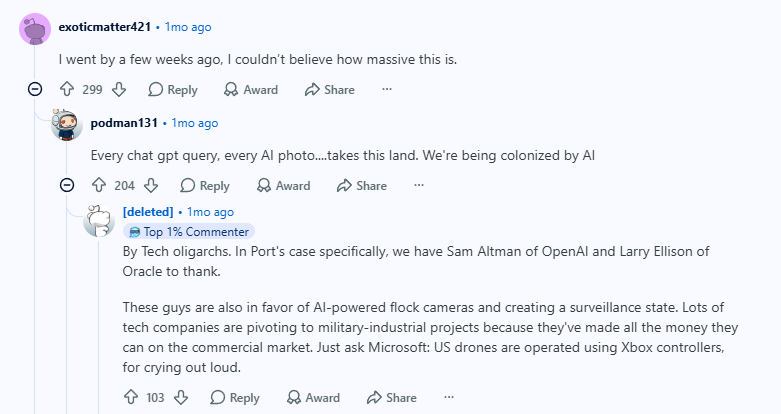
It's difficult for the folks in the tech bubble to understand, but people aren't seeing the value in AI, yet. The benefits of a large data center build out feel abstract, and unrelated to the lives of the average Wisconsinite. When people do not see the upside, the infrastructure looks like extraction.
A spring we may never tap
Outside of the futurist narratives speculating a "coming superintelligence" that parades the cocktail parties of SF, the benefits of AI are real now. AI is already helping researchers design new materials, accelerate drug discovery, detect disease earlier, translate language, write software, tutor students, and coordinate complex medical care. Sid Sijbrandij, founder of GitLab, cured his own bone cancer with AI as a research assistant and coordination layer inside an aggressive, personalized oncology effort.
The most emotionally clarifying example, to me, is breast cancer. Some cancers are missed by normal screening and appear between mammograms. These are called interval cancers. A woman can do everything right, get screened, receive a normal result, and still develop symptoms before her next appointment. In 2026, Nature Oncology found that AI caught 25% of these missed cancers, dramatically increasing the time-to-treatment and giving these women a better chance to fight for their life that they weren't given until AI.
We are witnessing the smallest glimpse into what abundant intelligence could provide Americans and, broadly, humanity. We will never get there unless the narrative changes. The people, and the politicians who represent the interests of their people, will fight tooth-and-nail against these data centers.
Currently, the techno-optimists of the West Coast are losing. The stakes are too high to discard America's heartland, mutter "they just don't understand," and resume business assuming they won't fight back – because they are. Intelligence must become as abundant as running water, and if America wants to remain the place where AI is built, powered, and governed, we need to pave the way for an emphatic "yes, in my backyard."
What's being built in Port Washington
The Vantage Data Centers' "Lighthouse" campus in Port Washington, Wisconsin, tied to OpenAI and Oracle's Stargate expansion, will cost $15 billion, span 672 acres, include four single-story data centers, total about 2.5 million sq. ft., provide roughly 902MW / close to 1GW of compute capacity, and be completed around 2028.
The site is about 1 mile inland from Lake Michigan, mostly on former/agricultural land. Vantage owns a larger 1,644-acre property, but the proposed campus is on the southern 672 acres.
The site is incredible. A birds-eye map does not do it justice. For comparison, the entire 1,600+ acres is roughly equivalent to: 3 Disneyland Resorts, 2 Central Parks, or 1,212 football fields. The data center portion alone is larger than a single Disneyland Resort.
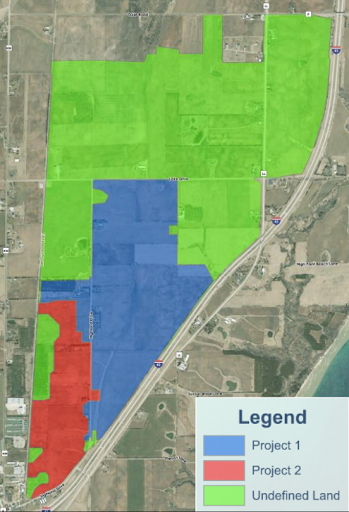
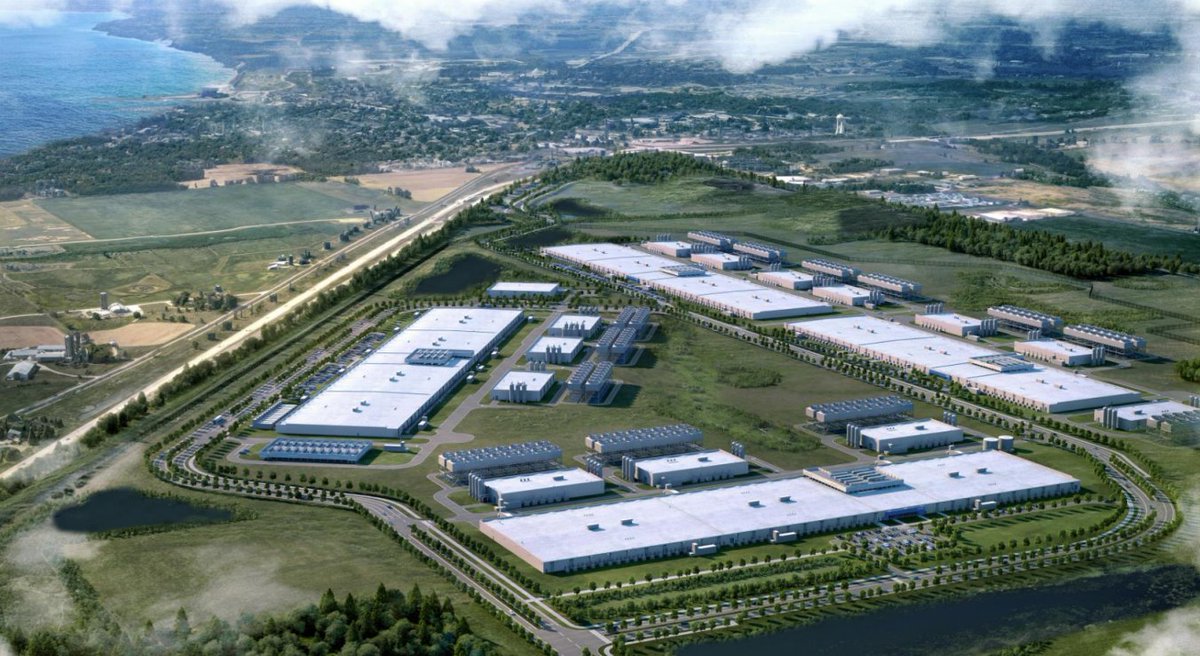
The map of the land depicts three different sites. The site for Project 1 which includes three buildings, an operations center, and a warehouse. Project 2 will hold 1 building, leaving 1,000+ acres of "undefined" land that Vantage owns.
The sheer scale of the project matters. When a data center stops looking like infrastructure and starts looking like the future eating the landscape, it becomes an easy target for politicians looking for something to fight.
The Buildout meets the ballot box
Politicians on both sides of the aisle are positioning themselves as "anti-data center" and they are winning. When they win, they'll make it impossible to build anywhere.
Francesca Hong, the leading Democratic candidate for Wisconsin Governor, has called AI data centers "a bad deal for Wisconsin" and called for a moratorium until environmental and energy protections are clearer.
Tom Tiffany, the leading Republican candidate for Wisconsin Governor, promises he'll "stop Big Data from bull-dozing our farmland."
Regardless of who wins the gubernatorial election in a few months, it's clear where they stand on the Great Buildout and what's in Wisconsin's future.
The national cost of local rejection
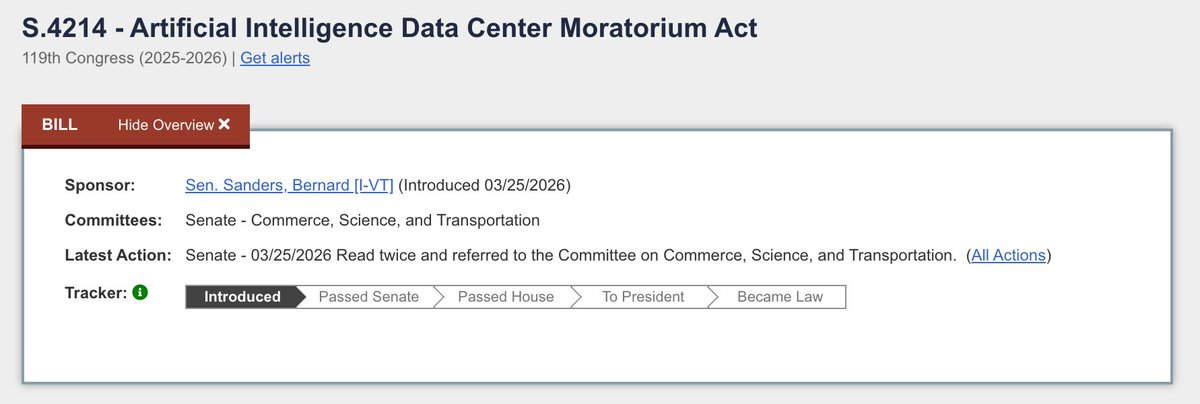
The problem in Port Washington transcends Wisconsin to the national stage, and the stakes have never been higher. Sen. Sanders, with Congresswoman Ocasio-Cortez co-authoring, recently introduced a bill to pause all data center construction at the Federal level.
For Vantage, OpenAI, Oracle, and everyone financing the AI buildout, setting a credible example of a "civic data center" is existential. Stargate only works if sites can be permitted, powered, built, and accepted. Compute must be hosted somewhere.
If compute is moved off-shore, we risk the sovereignty, security, energy dependence, and strategic geo-political positioning of one of the greatest technologies ever invented. It's an immediate secession as the global Intelligence Hegemon, as we don't control whether the data centers' power buttons are ON or OFF.
The next-best thing is moving compute to space, where many industry-leaders are heading. It's an exciting image; one that feels techno-optimistic because there finally might be a use-case where the economics make sense to put something in space rather than on Earth.
Assuming the engineering challenges (heat sink, reliable power, repairs, etc.) are resolved – because Elon and the SpaceX team will likely always find a way – there still remains the issue that they are incredibly vulnerable to attack from foreign adversaries in orbit where we cannot defend them.
Perhaps even that's resolved in some way with major defense upgrades, but the real danger is that once AI infrastructure leaves America, so do all the benefits. The jobs, tax base, grid upgrades, public investments, civic amenities, and the sense that the future is built here – not somewhere else – will all be gone.
Vantage's incredible opportunity
Vantage has an incredible opportunity to flip the narrative on not only their Port Washington data center, but the entire Stargate program and American Data Center Buildout. For Wisconsinites to embrace the data center, they need to feel like it's dramatically giving more than taking. If they succeed, it can become a blueprint for data centers around the country and the machines can co-exist wonderfully with the communities who birthed them.
Currently, Vantage outlines a plan for how they'll build the land around the Lighthouse data center to mitigate environmental and cultural impact. The plan includes the basic ingredients: 8-foot landscaped berms for some visual / audio shielding, tree screenings along the highway that will grow tall enough to (maybe) hide the data center after 30 years of growth, exterior lighting to preserve light pollution – so neighbors can enjoy a beautiful night-sky – and some others.
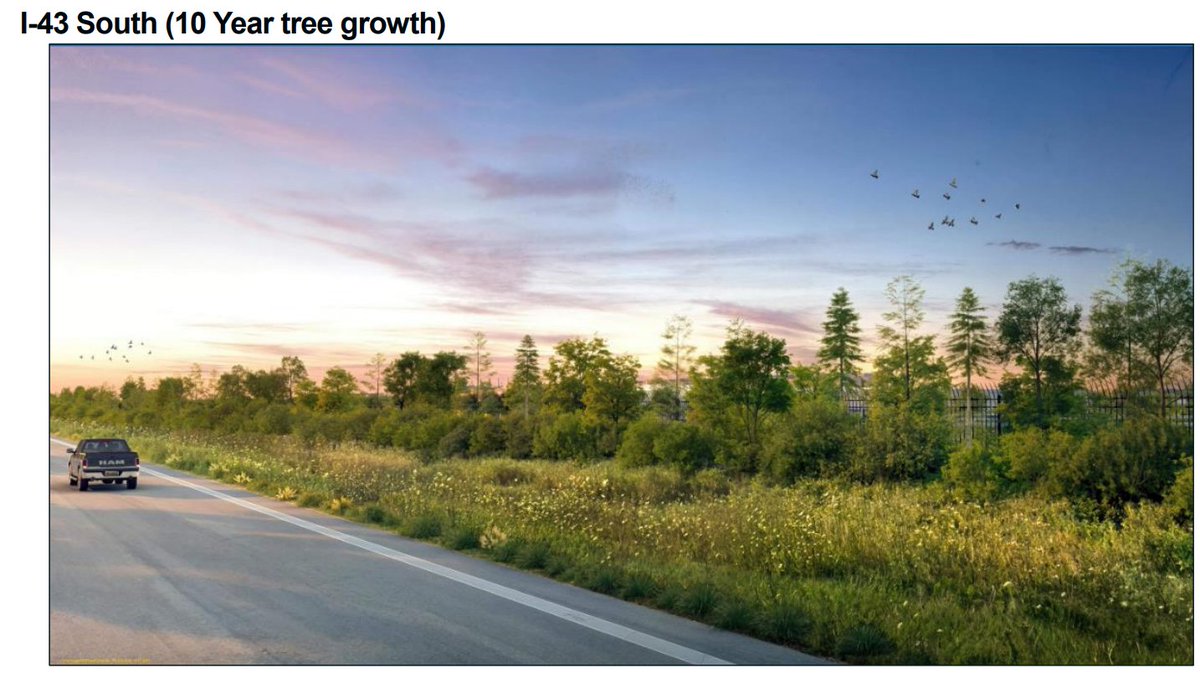
10 years of growth
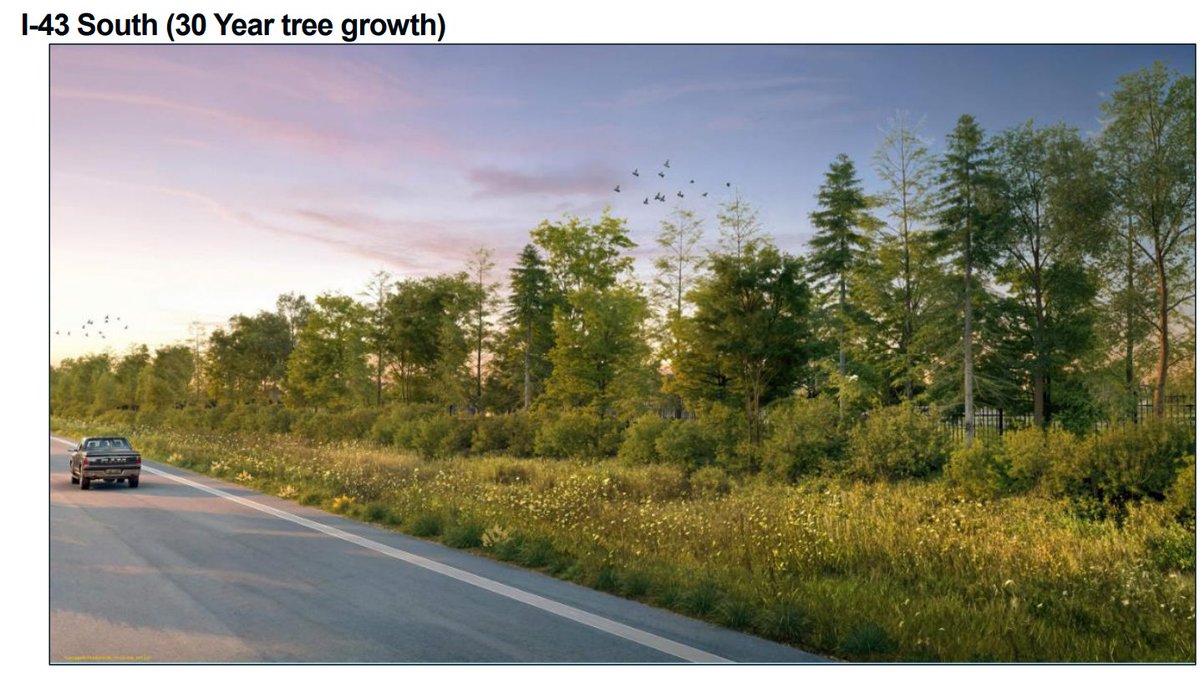
30 years of growth
This plan is useful, but it's emotionally thin. The renderings feel weak and sad because they read like compliance landscaping. The proposal laid out in this article is an extension of the existing plan. It gives Port Washington something more ambitious – something residents deserve: The Great Lakes Garden, a four-season public landscape of bird habitat, fishing ponds, forested walking paths, wetlands, and dense native tree canopy designed to make the Lighthouse campus disappear into a living Great Lakes landscape.
Why not just pay residents?
Some will suggest just paying the residents directly. This route seems simple and fair at first glance, until you realize it really creates a new asset attached to residency.
If every Port Washington household receives $5,000 a year, then the right to live in Port Washington becomes worth something like a bond. Buyers will pay more for homes that carry the dividend. Landlords will know tenants have extra annual income. Over time, part of the payment meant to compensate residents will be captured by the owners of scarce housing.
The Alaska Permanent Fund is the strongest argument for a resource dividend like this, which pays $1,229 per person/year (on average) annually to Alaskan residents ($1,000 in 2025) from oil revenues. However, this is shared across the whole state. A Port Washington dividend would be different, as it would attach cash to one small municipal boundary, turning residency itself into something like a bond.
One might ask, then, why not make the dividend statewide like Alaska's?
That would solve the local problem, but Wisconsin has 2.48 million households. Even paying $1,000 per household – not per person, like Alaska – would cost nearly $2.5 billion every year. Alaska can sustain its model because a relatively small population shares a massive, long-accumulated oil fund. Wisconsin would be asking a handful of data centers to fund a permanent statewide entitlement.
A civic data center, like the Great Lakes Garden, avoids both failures. It does not turn residency into a financial instrument. It turns the burden of hosting national AI infrastructure into permanent public wealth: land, habitat, trails, trees, and a gathering space for residents.
The Concept
The idea of the Great Lakes Garden is rooted in Ozaukee County's existing bird stewardship, in combination with Wisconsinites' proclivity towards outdoor activities and love of nature. Lake Michigan serves as a major migratory corridor because birds often follow coastlines, as they provide orientation, food, shelter, and stopover habitat.
The county the data center resides in has maintained Bird City Wisconsin High-Flyer status since 2010, a prestigious award given to counties in Wisconsin who support birds through habitat creation, protection, and an extraordinary amount of conservation work.
There's four components to this proposal for extension: woodland acoustic buffers, bird-first habitat, exploratory trails, and a year-round community space and learning center.
Acoustic Buffers
The acoustic buffers are not just 8-foot berms to shield the public from the data center, as first drafted. They are layered berms, hidden acoustic walls, conifers, deciduous trees, and shrubs on the edges facing homes/trails/roads, which not only shield the concrete views from the public, but also any and all sounds that come with the industrialization of the land for all the neighbors and visitors of the Garden.
Bird-first Habitat
The bird-first habitat is made up of wetlands, habitat ponds, native understory, pollinator corridors, nesting structures, and bird-safe lighting.
Public Trails
In addition, visitors from around the state could travel here and get lost in exploration among the overlooks, boardwalks, and other walking paths covering the preserve.
Year-round Family Community Space
The winters in Wisconsin can be brutal; the learning center is the hub of the Garden where families can come year-round, warm or cold, and enjoy indoor amenities like nature exhibits, a cafe, and an indoor playground for kids to play tag or "the floor is lava", and make memories with other kids.
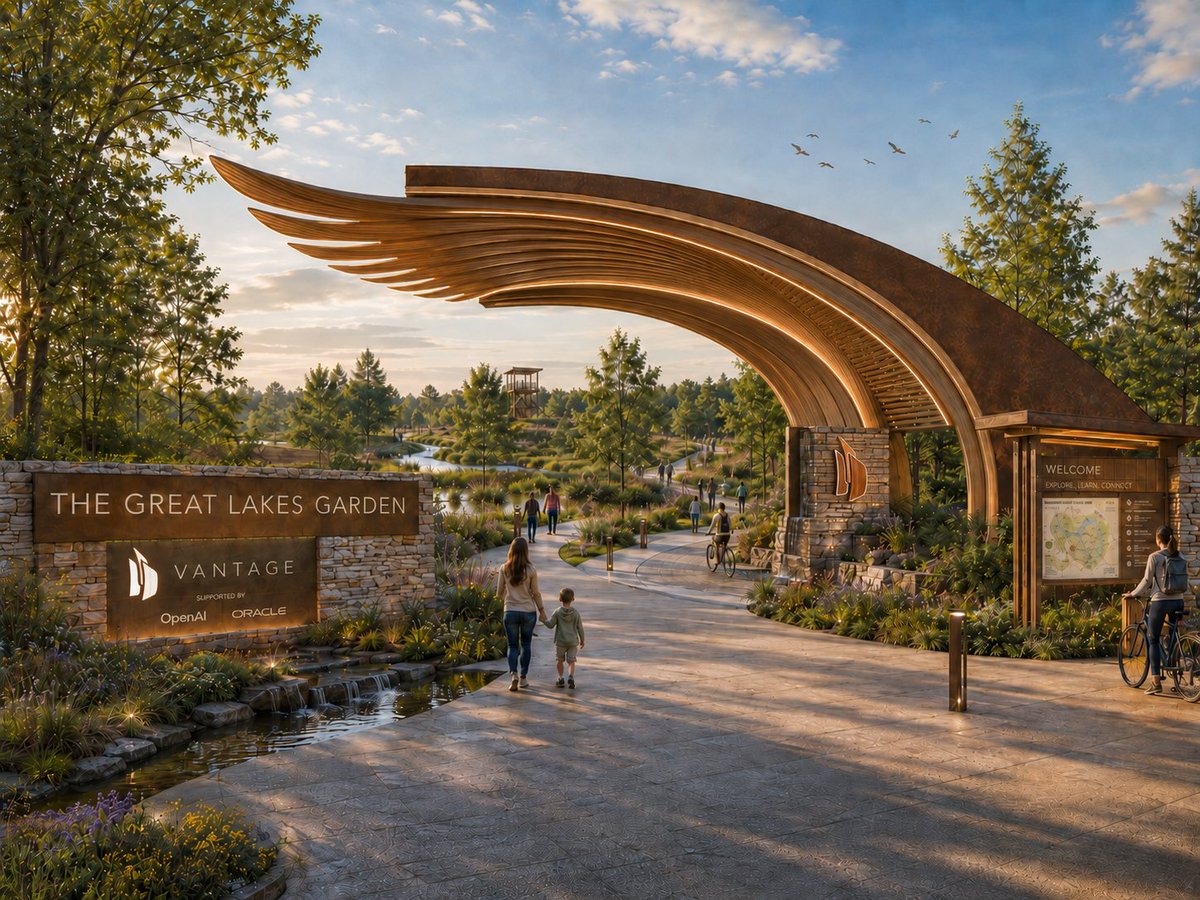
Garden entrance
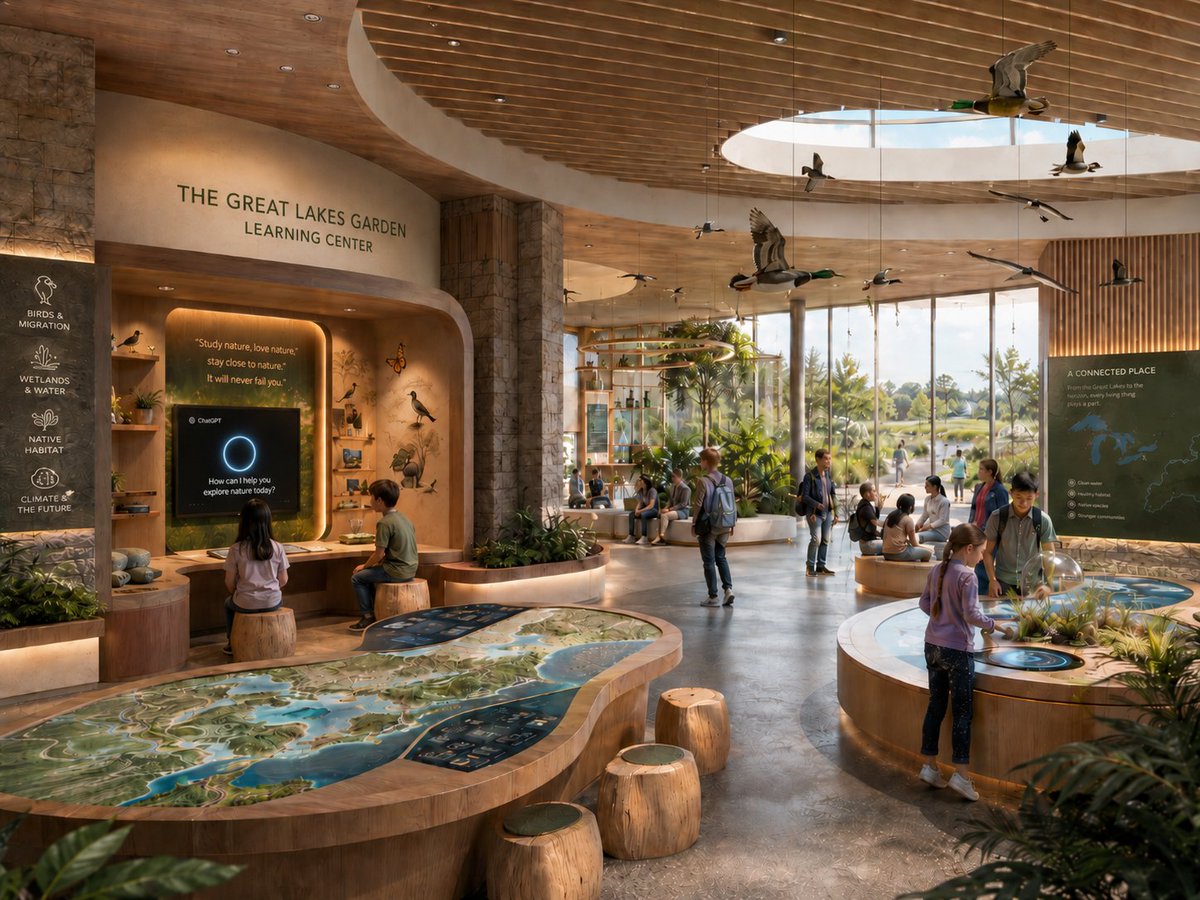
Learning Center
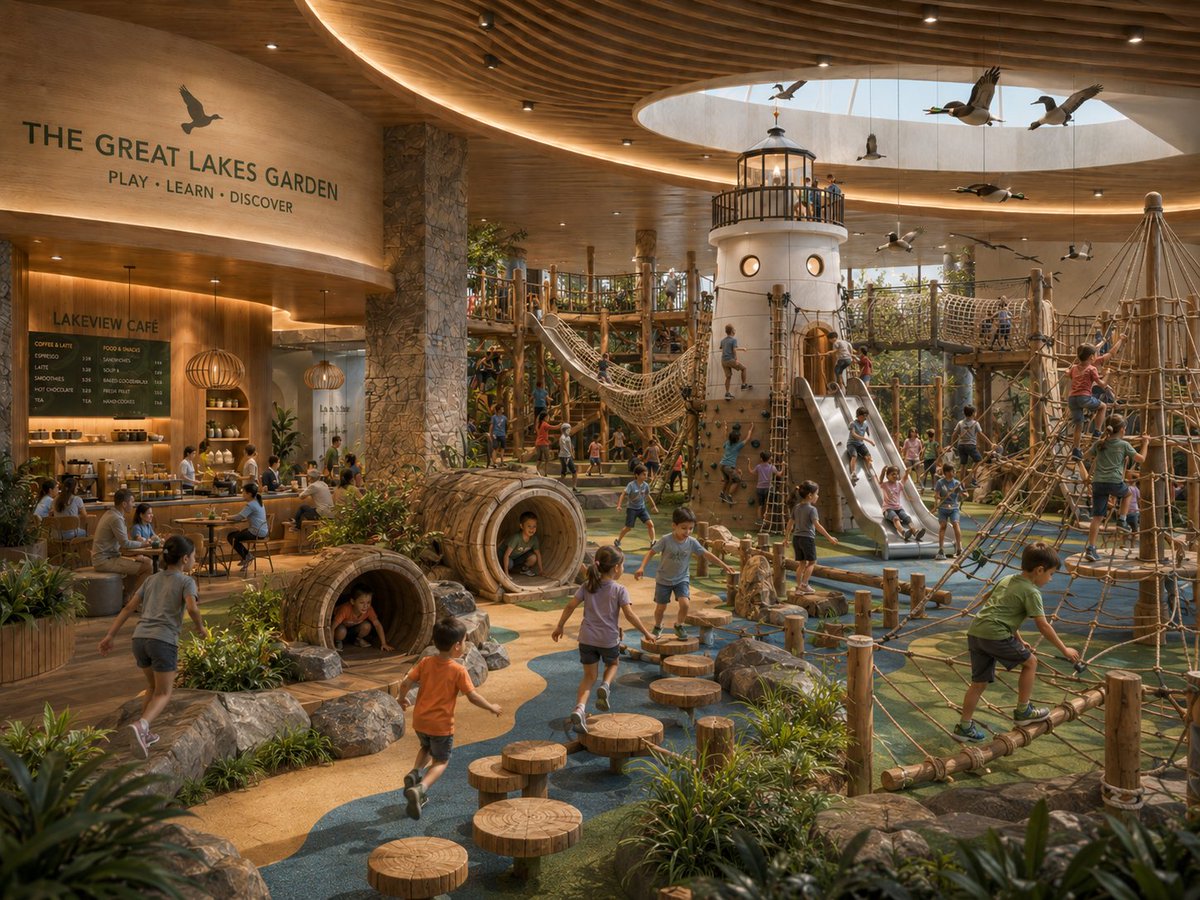
Playground and cafe
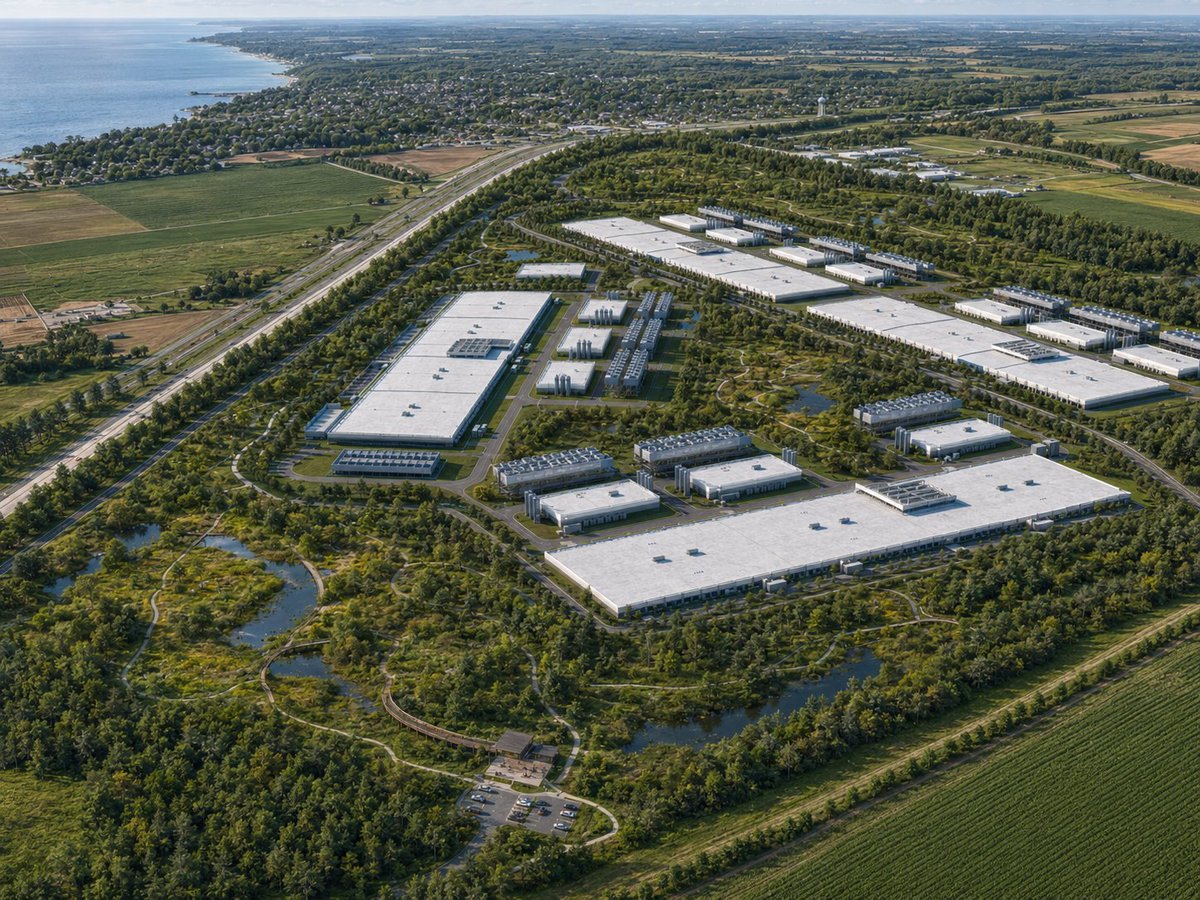
Aerial with garden
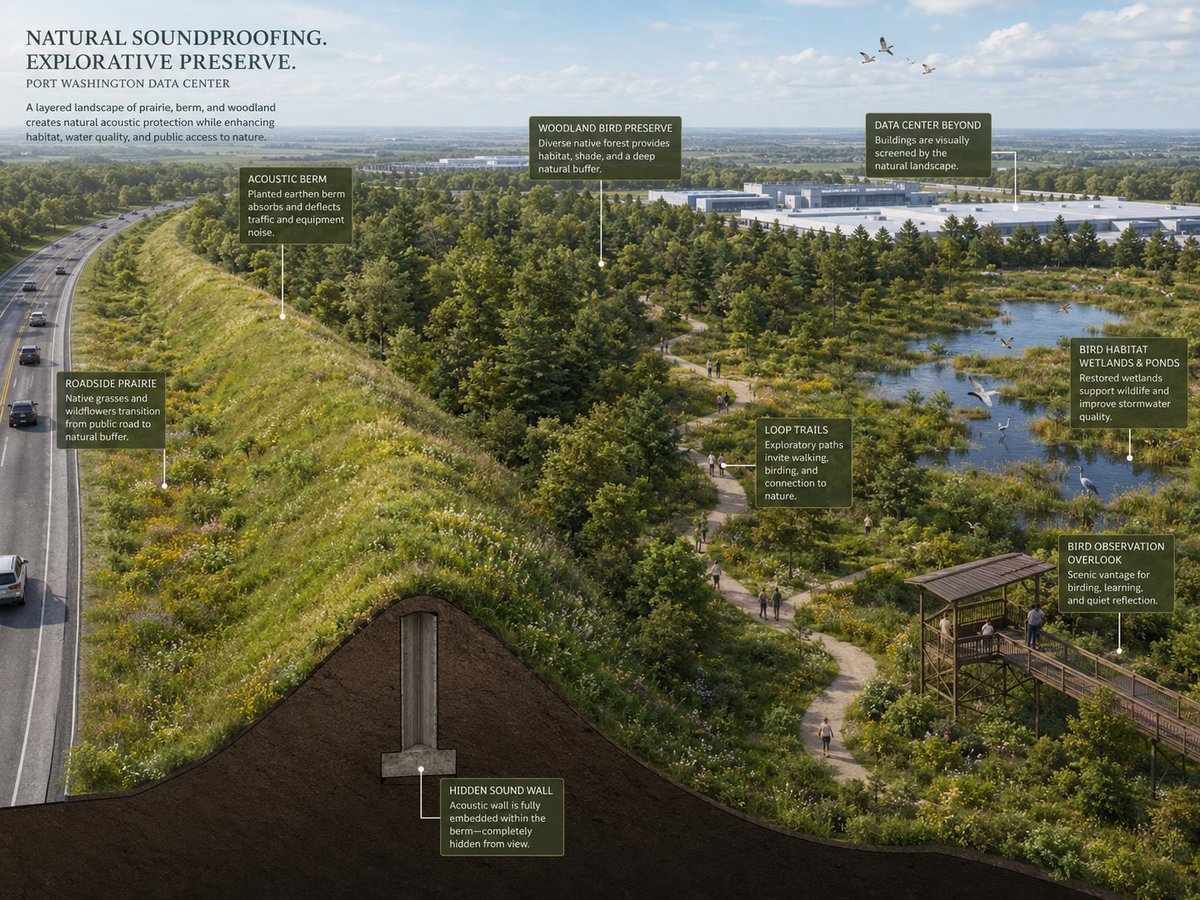
Soundproofing cross-section
As an interesting note on the existing finances for the environment around the current data center, Vantage is given the opportunity to qualify for a reimbursement potentially between $450 million and $458 million if they spend $175 million for eligible public infrastructure – things like landscaping, roads, and trail connections to the close-by Ozaukee County "Interurban Trail" – through what's called a "tax increment district" (TID). So, the project already sits inside a financing structure where Vantage is incentivized to build public infrastructure, landscaping, roads, and trail connections.
The World's First Civic Data Center
The Port Washington data center can either become another symbol of local resistance to AI infrastructure, or a national model for how to build data centers in a way that communities can say yes to.
If America makes data centers impossible to love, it will not stop the AI buildout. It will only push the physical foundation of AI into places where Americans have less control, less benefit, and less claim.
The Port Washington "Lighthouse" data center has a unique opportunity where the project hasn't been cancelled, but still faces cultural hostility, to change the narrative of data centers, give the community a relic they'll cherish, and become a beacon of human prosperity in America as Earth's first civic data center.